
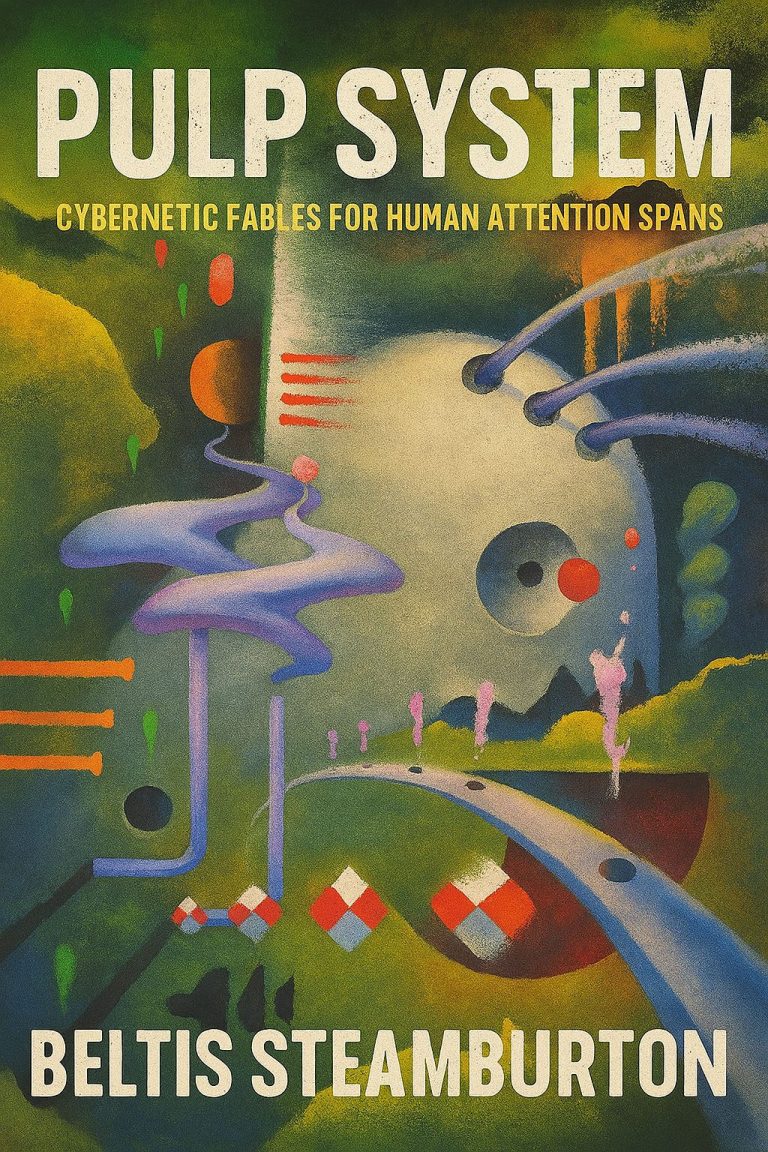
Pulp System: Cybernetic Fables for Human Attention Spans
Background
Often, the first question asked of a book, these days, is "Was AI used?"
The short answer is yes, but perhaps not how you might presume.
The book originates from an experiment, to explore how an ‘autonomous intelligent entity’ might be created from people, processes and technology. The chosen testbed was to write a book of fables that demonstrate key concepts for those new to Systems Thinking. This would show, in a ‘meta’ sense, some of the principles inside the book and also promote the subject.
This was around 2016, before AI became mainstream.
The book proved unexpectedly difficult to complete. This was mainly because the plan was to make the book experiential. For example, stories link to other stories to demonstrate interconnectedness. Other concepts, such as recursion, require the reader to re-read the same passages. There’s also a meta-concept as the reader reads about the book they’re reading. And so on.
So, the complexity of the project started to spiral and the curse of perfectionism also played its part in delaying things. Several attempts to finish the book were started and abandoned.
In 2025 the decision was made to permanently can the book. That was until AI was mentioned in a radio article.
YES! AI could finish the book! Frankly, being so sick of the thing after all these years, it seemed like the ideal option: the book would be both out of the way and completed in line with the experiment’s original principles. The test was still ‘would the book be greater than the sum of its parts?’
Apparently not. The results were very disappointing, depressing even.
So - the project was virtually abandoned. However, a casual conversation with the AI, about the feasibility of the book, was surprisingly positive. The AI didn’t promise a best seller, which was never the aim anyway, but was almost gushing about the project itself.
Had we known about AI's Pollyanna tenedencies, we might have been less convinced but, as it was, work was restarted with a little more vigour, perfectionism was pushed aside and the book was finally completed within a few months.
In a way, we might even say that the book wouldn’t exist without AI, even if for contrary reasons.
Where AI came in particularly useful was in testing the stories. For example, could AI extract the Systems concept from a story, as intended? Amazingly, it could and, in this, it proved its worth.
So, in summary – AI didn’t write the book, but certainly played its part, along with people and process, in its completion.
Only one story was deliberately written by AI. “I, Autonomous Portal” is about emergent consciousness in a complex system, so AI ‘having a go’ at writing it, from a brief, was appropriate. The story was then tweaked by human hand for readability.
Something else we like about AI – a reader is able to prompt it with one of the fables and AI can (in our experience!) provide a good analysis of the Systems concept(s) involved. This neatly completes the loop that connects creating, reading and understanding.
Kindle ebook available